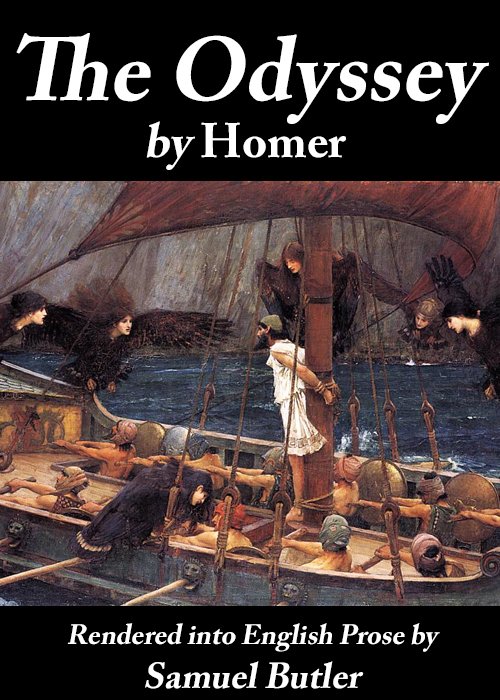

The Odyssey
Chapter/Book 1
of yet another kind; for the chiefs from all our islands, Dulichium, Same, and the woodland island of Zacynthus, as also all the principal men of Ithaca itself, are eating up my house under the pretext of paying their court to my mother, who will neither point blank say that she will not marry,[7] nor yet bring matters to an end; so they are making havoc of my estate, and before long will do so also with myself.”
“Is that so?” exclaimed Minerva, “then you do indeed want Ulysses home again. Give him his helmet, shield, and a couple of lances, and if he is the man he was when I first knew him in our house, drinking and making merry, he would soon lay his hands about these rascally suitors, were he to stand once more upon his own threshold. He was then coming from Ephyra, where he had been to beg poison for his arrows from Ilus, son of Mermerus. Ilus feared the ever-living gods and would not give him any, but my father let him have some, for he was very fond of him. If Ulysses is the man he then was these suitors will have a short shrift and a sorry wedding.
“But there! It rests with heaven to determine whether he is to return, and take his revenge in his own house or no; I would, however, urge you to set about trying to get rid of these suitors at once. Take my advice, call the Achaean heroes in assembly to-morrow morning—lay your case before them, and call heaven to bear you witness. Bid the suitors take themselves off, each to his own place, and if your mother’s mind is set on marrying again, let her go back to her father, who will find her a husband and provide her with all the marriage gifts that so dear a daughter may expect. As for yourself, let me prevail upon you to take the best ship you can get, with a crew of twenty men, and go in quest of your father who has so long been missing. Some one may tell you something, or (and people often hear things in this way) some heaven-sent message may direct you. First go to Pylos and ask Nestor; thence go on to Sparta and visit Menelaus, for he got home last of all the Achaeans; if you hear that your father is alive and on his way home, you can put up with the waste these suitors will make for yet another twelve months. If on the other hand you hear of his death, come home at once, celebrate his funeral rites with all due pomp, build a barrow to his memory, and make your mother marry again. Then, having done all this, think it well over in your mind how, by fair means or foul, you may kill these suitors in your own house. You are too old to plead infancy any longer; have you not heard how people are singing Orestes’ praises for having killed his father’s murderer Aegisthus? You are a fine, smart looking fellow; show your mettle, then, and make yourself a name in story. Now, however, I must go back to my ship and to my crew, who will be impatient if I keep them waiting longer; think the matter over for yourself, and remember what I have said to you.”
“Sir,” answered Telemachus, “it has been very kind of you to talk to me in this way, as though I were your own son, and I will do all you tell me; I know you want to be getting on with your voyage, but stay a little longer till you have taken a bath and refreshed yourself. I will then give you a present, and you shall go on your way rejoicing; I will give you one of great beauty and value—a keepsake such as only dear friends give to one another.”
Minerva answered, “Do not try to keep me, for I would be on my way at once. As for any present you may be disposed to make me, keep it till I come again, and I will take it home with me. You shall give me a very good one, and I will give you one of no less value in return.”
With these words she flew away like a bird into the air, but she had given Telemachus courage, and had made him think more than ever about his father. He felt the change, wondered at it, and knew that the stranger had been a god, so he went straight to where the suitors were sitting.
Phemius was still singing, and his hearers sat rapt in silence as he told the sad tale of the return from Troy, and the ills Minerva had laid upon the Achaeans. Penelope, daughter of Icarius, heard his song from her room upstairs, and came down by the great staircase, not alone, but attended by two of her handmaids. When she reached the suitors she stood by one of the bearing posts that supported the roof of the cloisters[8] with a staid maiden on either side of her. She held a veil, moreover, before her face, and was weeping bitterly.
“Phemius,” she cried, “you know many another feat of gods and heroes, such as poets love to celebrate. Sing the suitors some one of these, and let them drink their wine in silence, but cease this sad tale, for it breaks my sorrowful heart, and reminds me of my lost husband whom I mourn ever without ceasing, and whose name was great over all Hellas and middle Argos.”[9]
“Mother,” answered Telemachus, “let the bard sing what he has a mind to; bards do not make the ills they sing of; it is Jove, not they, who makes them, and who sends weal or woe upon mankind according to his own good pleasure. This fellow means no harm by singing the ill-fated return of the Danaans, for people always applaud the latest songs most warmly. Make up your mind to it and bear it; Ulysses is not the only man who never came back from Troy, but many another went down as well as he. Go, then, within the house and busy yourself with your daily duties, your loom, your distaff, and the ordering of your servants; for speech is man’s matter, and mine above all others [10]—for it is I who am master here.”
She went wondering back into the house, and laid her son’s saying in her heart. Then, going upstairs with her handmaids into her room, she mourned her dear husband till Minerva shed sweet sleep over her eyes. But the suitors were clamorous throughout the covered cloisters[11], and prayed each one that he might be her bed fellow.
Then Telemachus spoke, “Shameless,” he cried, “and insolent suitors, let us feast at our pleasure now, and let there be no brawling, for it is a rare thing to hear a man with such a divine voice as Phemius has; but in the morning meet me in full assembly that I may give you formal notice to depart, and feast at one another’s houses, turn and turn about, at your own cost. If on the other hand you choose to persist in spunging upon one man, heaven help me, but Jove shall reckon with you in full, and when you fall in my father’s house there shall be no man to avenge you.”
The suitors bit their lips as they heard him, and marvelled at the boldness of his speech. Then, Antinous, son of Eupeithes, said, “The gods seem to have given you lessons in bluster and tall talking; may Jove never grant you to be chief in Ithaca as your father was before you.”
Telemachus answered, “Antinous, do not chide with me, but, god willing, I will be chief too if I can. Is this the worst fate you can think of for me? It is no bad thing to be a chief, for it brings both riches and honour. Still, now that Ulysses is dead there are many great men in Ithaca both old and young, and some other may take the lead among them; nevertheless I will be chief in my own house, and will rule those whom Ulysses has won for me.”
Then Eurymachus, son of Polybus, answered, “It rests with heaven to decide who shall be chief among us, but you shall be master in your own house and over your own possessions; no one while there is a man in Ithaca shall do you violence nor rob you. And now, my good fellow, I want to know about this stranger. What country does he come from? Of what family is he, and where is his estate? Has he brought you news about the return of your father, or was he on business of his own? He seemed a well to do man, but he hurried off so suddenly that he was gone in a moment before we could get to know him.”
“My father is dead and gone,” answered Telemachus, “and even if some rumour reaches me I put no more faith in it now. My mother does indeed sometimes send for a soothsayer and question him, but I give his prophecyings no heed. As for the stranger, he was Mentes, son of Anchialus, chief of the Taphians, an old friend of my father’s.” But in his heart he knew that it had been the goddess.
The suitors then returned to their singing and dancing until the evening; but when night fell upon their pleasuring they went home to bed each in his own abode.[12] Telemachus’s room was high up in a tower[13] that looked on to the outer court; hither, then, he hied, brooding and full of thought. A good old woman, Euryclea, daughter of Ops, the son of Pisenor, went before him with a couple of blazing torches. Laertes had bought her with his own money when she was quite young; he gave the worth of twenty oxen for her, and shewed as much respect to her in his household as he did to his own wedded wife, but he did not take her to his bed for he feared his wife’s resentment.[14] She it was who now lighted Telemachus to his room, and she loved him better than any of the other women in the house did, for she had nursed him when he was a baby. He opened the door of his bed room and sat down upon the bed; as he took off his shirt[15] he gave it to the good old woman, who folded it tidily up, and hung it for him over a peg by his bed side, after which she went out, pulled the door to by a silver catch, and drew the bolt home by means of the strap.[16] But Telemachus as he lay covered with a woollen fleece kept thinking all night through of his intended voyage and of the counsel that Minerva had given him.
“Is that so?” exclaimed Minerva, “then you do indeed want Ulysses home again. Give him his helmet, shield, and a couple of lances, and if he is the man he was when I first knew him in our house, drinking and making merry, he would soon lay his hands about these rascally suitors, were he to stand once more upon his own threshold. He was then coming from Ephyra, where he had been to beg poison for his arrows from Ilus, son of Mermerus. Ilus feared the ever-living gods and would not give him any, but my father let him have some, for he was very fond of him. If Ulysses is the man he then was these suitors will have a short shrift and a sorry wedding.
“But there! It rests with heaven to determine whether he is to return, and take his revenge in his own house or no; I would, however, urge you to set about trying to get rid of these suitors at once. Take my advice, call the Achaean heroes in assembly to-morrow morning—lay your case before them, and call heaven to bear you witness. Bid the suitors take themselves off, each to his own place, and if your mother’s mind is set on marrying again, let her go back to her father, who will find her a husband and provide her with all the marriage gifts that so dear a daughter may expect. As for yourself, let me prevail upon you to take the best ship you can get, with a crew of twenty men, and go in quest of your father who has so long been missing. Some one may tell you something, or (and people often hear things in this way) some heaven-sent message may direct you. First go to Pylos and ask Nestor; thence go on to Sparta and visit Menelaus, for he got home last of all the Achaeans; if you hear that your father is alive and on his way home, you can put up with the waste these suitors will make for yet another twelve months. If on the other hand you hear of his death, come home at once, celebrate his funeral rites with all due pomp, build a barrow to his memory, and make your mother marry again. Then, having done all this, think it well over in your mind how, by fair means or foul, you may kill these suitors in your own house. You are too old to plead infancy any longer; have you not heard how people are singing Orestes’ praises for having killed his father’s murderer Aegisthus? You are a fine, smart looking fellow; show your mettle, then, and make yourself a name in story. Now, however, I must go back to my ship and to my crew, who will be impatient if I keep them waiting longer; think the matter over for yourself, and remember what I have said to you.”
“Sir,” answered Telemachus, “it has been very kind of you to talk to me in this way, as though I were your own son, and I will do all you tell me; I know you want to be getting on with your voyage, but stay a little longer till you have taken a bath and refreshed yourself. I will then give you a present, and you shall go on your way rejoicing; I will give you one of great beauty and value—a keepsake such as only dear friends give to one another.”
Minerva answered, “Do not try to keep me, for I would be on my way at once. As for any present you may be disposed to make me, keep it till I come again, and I will take it home with me. You shall give me a very good one, and I will give you one of no less value in return.”
With these words she flew away like a bird into the air, but she had given Telemachus courage, and had made him think more than ever about his father. He felt the change, wondered at it, and knew that the stranger had been a god, so he went straight to where the suitors were sitting.
Phemius was still singing, and his hearers sat rapt in silence as he told the sad tale of the return from Troy, and the ills Minerva had laid upon the Achaeans. Penelope, daughter of Icarius, heard his song from her room upstairs, and came down by the great staircase, not alone, but attended by two of her handmaids. When she reached the suitors she stood by one of the bearing posts that supported the roof of the cloisters[8] with a staid maiden on either side of her. She held a veil, moreover, before her face, and was weeping bitterly.
“Phemius,” she cried, “you know many another feat of gods and heroes, such as poets love to celebrate. Sing the suitors some one of these, and let them drink their wine in silence, but cease this sad tale, for it breaks my sorrowful heart, and reminds me of my lost husband whom I mourn ever without ceasing, and whose name was great over all Hellas and middle Argos.”[9]
“Mother,” answered Telemachus, “let the bard sing what he has a mind to; bards do not make the ills they sing of; it is Jove, not they, who makes them, and who sends weal or woe upon mankind according to his own good pleasure. This fellow means no harm by singing the ill-fated return of the Danaans, for people always applaud the latest songs most warmly. Make up your mind to it and bear it; Ulysses is not the only man who never came back from Troy, but many another went down as well as he. Go, then, within the house and busy yourself with your daily duties, your loom, your distaff, and the ordering of your servants; for speech is man’s matter, and mine above all others [10]—for it is I who am master here.”
She went wondering back into the house, and laid her son’s saying in her heart. Then, going upstairs with her handmaids into her room, she mourned her dear husband till Minerva shed sweet sleep over her eyes. But the suitors were clamorous throughout the covered cloisters[11], and prayed each one that he might be her bed fellow.
Then Telemachus spoke, “Shameless,” he cried, “and insolent suitors, let us feast at our pleasure now, and let there be no brawling, for it is a rare thing to hear a man with such a divine voice as Phemius has; but in the morning meet me in full assembly that I may give you formal notice to depart, and feast at one another’s houses, turn and turn about, at your own cost. If on the other hand you choose to persist in spunging upon one man, heaven help me, but Jove shall reckon with you in full, and when you fall in my father’s house there shall be no man to avenge you.”
The suitors bit their lips as they heard him, and marvelled at the boldness of his speech. Then, Antinous, son of Eupeithes, said, “The gods seem to have given you lessons in bluster and tall talking; may Jove never grant you to be chief in Ithaca as your father was before you.”
Telemachus answered, “Antinous, do not chide with me, but, god willing, I will be chief too if I can. Is this the worst fate you can think of for me? It is no bad thing to be a chief, for it brings both riches and honour. Still, now that Ulysses is dead there are many great men in Ithaca both old and young, and some other may take the lead among them; nevertheless I will be chief in my own house, and will rule those whom Ulysses has won for me.”
Then Eurymachus, son of Polybus, answered, “It rests with heaven to decide who shall be chief among us, but you shall be master in your own house and over your own possessions; no one while there is a man in Ithaca shall do you violence nor rob you. And now, my good fellow, I want to know about this stranger. What country does he come from? Of what family is he, and where is his estate? Has he brought you news about the return of your father, or was he on business of his own? He seemed a well to do man, but he hurried off so suddenly that he was gone in a moment before we could get to know him.”
“My father is dead and gone,” answered Telemachus, “and even if some rumour reaches me I put no more faith in it now. My mother does indeed sometimes send for a soothsayer and question him, but I give his prophecyings no heed. As for the stranger, he was Mentes, son of Anchialus, chief of the Taphians, an old friend of my father’s.” But in his heart he knew that it had been the goddess.
The suitors then returned to their singing and dancing until the evening; but when night fell upon their pleasuring they went home to bed each in his own abode.[12] Telemachus’s room was high up in a tower[13] that looked on to the outer court; hither, then, he hied, brooding and full of thought. A good old woman, Euryclea, daughter of Ops, the son of Pisenor, went before him with a couple of blazing torches. Laertes had bought her with his own money when she was quite young; he gave the worth of twenty oxen for her, and shewed as much respect to her in his household as he did to his own wedded wife, but he did not take her to his bed for he feared his wife’s resentment.[14] She it was who now lighted Telemachus to his room, and she loved him better than any of the other women in the house did, for she had nursed him when he was a baby. He opened the door of his bed room and sat down upon the bed; as he took off his shirt[15] he gave it to the good old woman, who folded it tidily up, and hung it for him over a peg by his bed side, after which she went out, pulled the door to by a silver catch, and drew the bolt home by means of the strap.[16] But Telemachus as he lay covered with a woollen fleece kept thinking all night through of his intended voyage and of the counsel that Minerva had given him.
Chapter/Book 2
more, and entreat you no further, for the gods and the people of Ithaca now know my story. Give me, then, a ship and a crew of twenty men to take me hither and thither, and I will go to Sparta and to Pylos in quest of my father who has so long been missing. Some one may tell me something, or (and people often hear things in this way) some heaven-sent message may direct me. If I can hear of him as alive and on his way home I will put up with the waste you suitors will make for yet another twelve months. If on the other hand I hear of his death, I will return at once, celebrate his funeral rites with all due pomp, build a barrow to his memory, and make my mother marry again.”
With these words he sat down, and Mentor[20] who had been a friend of Ulysses, and had been left in charge of everything with full authority over the servants, rose to speak. He, then, plainly and in all honesty addressed them thus:
“Hear me, men of Ithaca, I hope that you may never have a kind and well-disposed ruler any more, nor one who will govern you equitably; I hope that all your chiefs henceforward may be cruel and unjust, for there is not one of you but has forgotten Ulysses, who ruled you as though he were your father. I am not half so angry with the suitors, for if they choose to do violence in the naughtiness of their hearts, and wager their heads that Ulysses will not return, they can take the high hand and eat up his estate, but as for you others I am shocked at the way in which you all sit still without even trying to stop such scandalous goings on—which you could do if you chose, for you are many and they are few.”
Leiocritus, son of Evenor, answered him saying, “Mentor, what folly is all this, that you should set the people to stay us? It is a hard thing for one man to fight with many about his victuals. Even though Ulysses himself were to set upon us while we are feasting in his house, and do his best to oust us, his wife, who wants him back so very badly, would have small cause for rejoicing, and his blood would be upon his own head if he fought against such great odds. There is no sense in what you have been saying. Now, therefore, do you people go about your business, and let his father’s old friends, Mentor and Halitherses, speed this boy on his journey, if he goes at all—which I do not think he will, for he is more likely to stay where he is till some one comes and tells him something.”
On this he broke up the assembly, and every man went back to his own abode, while the suitors returned to the house of Ulysses.
Then Telemachus went all alone by the sea side, washed his hands in the grey waves, and prayed to Minerva.
“Hear me,” he cried, “you god who visited me yesterday, and bade me sail the seas in search of my father who has so long been missing. I would obey you, but the Achaeans, and more particularly the wicked suitors, are hindering me that I cannot do so.”
As he thus prayed, Minerva came close up to him in the likeness and with the voice of Mentor. “Telemachus,” said she, “if you are made of the same stuff as your father you will be neither fool nor coward henceforward, for Ulysses never broke his word nor left his work half done. If, then, you take after him, your voyage will not be fruitless, but unless you have the blood of Ulysses and of Penelope in your veins I see no likelihood of your succeeding. Sons are seldom as good men as their fathers; they are generally worse, not better; still, as you are not going to be either fool or coward henceforward, and are not entirely without some share of your father’s wise discernment, I look with hope upon your undertaking. But mind you never make common cause with any of those foolish suitors, for they have neither sense nor virtue, and give no thought to death and to the doom that will shortly fall on one and all of them, so that they shall perish on the same day. As for your voyage, it shall not be long delayed; your father was such an old friend of mine that I will find you a ship, and will come with you myself. Now, however, return home, and go about among the suitors; begin getting provisions ready for your voyage; see everything well stowed, the wine in jars, and the barley meal, which is the staff of life, in leathern bags, while I go round the town and beat up volunteers at once. There are many ships in Ithaca both old and new; I will run my eye over them for you and will choose the best; we will get her ready and will put out to sea without delay.”
Thus spoke Minerva daughter of Jove, and Telemachus lost no time in doing as the goddess told him. He went moodily home, and found the suitors flaying goats and singeing pigs in the outer court. Antinous came up to him at once and laughed as he took his hand in his own, saying, “Telemachus, my fine fire-eater, bear no more ill blood neither in word nor deed, but eat and drink with us as you used to do. The Achaeans will find you in everything—a ship and a picked crew to boot—so that you can set sail for Pylos at once and get news of your noble father.”
“Antinous,” answered Telemachus, “I cannot eat in peace, nor take pleasure of any kind with such men as you are. Was it not enough that you should waste so much good property of mine while I was yet a boy? Now that I am older and know more about it, I am also stronger, and whether here among this people, or by going to Pylos, I will do you all the harm I can. I shall go, and my going will not be in vain—though, thanks to you suitors, I have neither ship nor crew of my own, and must be passenger not captain.”
As he spoke he snatched his hand from that of Antinous. Meanwhile the others went on getting dinner ready about the buildings,[21] jeering at him tauntingly as they did so.
“Telemachus,” said one youngster, “means to be the death of us; I suppose he thinks he can bring friends to help him from Pylos, or again from Sparta, where he seems bent on going. Or will he go to Ephyra as well, for poison to put in our wine and kill us?”
Another said, “Perhaps if Telemachus goes on board ship, he will be like his father and perish far from his friends. In this case we should have plenty to do, for we could then divide up his property amongst us: as for the house we can let his mother and the man who marries her have that.”
This was how they talked. But Telemachus went down into the lofty and spacious store-room where his father’s treasure of gold and bronze lay heaped up upon the floor, and where the linen and spare clothes were kept in open chests. Here, too, there was a store of fragrant olive oil, while casks of old, well-ripened wine, unblended and fit for a god to drink, were ranged against the wall in case Ulysses should come home again after all. The room was closed with well-made doors opening in the middle; moreover the faithful old house-keeper Euryclea, daughter of Ops the son of Pisenor, was in charge of everything both night and day. Telemachus called her to the store-room and said:
“Nurse, draw me off some of the best wine you have, after what you are keeping for my father’s own drinking, in case, poor man, he should escape death, and find his way home again after all. Let me have twelve jars, and see that they all have lids; also fill me some well-sewn leathern bags with barley meal—about twenty measures in all. Get these things put together at once, and say nothing about it. I will take everything away this evening as soon as my mother has gone upstairs for the night. I am going to Sparta and to Pylos to see if I can hear anything about the return of my dear father.”
When Euryclea heard this she began to cry, and spoke fondly to him, saying, “My dear child, what ever can have put such notion as that into your head? Where in the world do you want to go to—you, who are the one hope of the house? Your poor father is dead and gone in some foreign country nobody knows where, and as soon as your back is turned these wicked ones here will be scheming to get you put out of the way, and will share all your possessions among themselves; stay where you are among your own people, and do not go wandering and worrying your life out on the barren ocean.”
“Fear not, nurse,” answered Telemachus, “my scheme is not without heaven’s sanction; but swear that you will say nothing about all this to my mother, till I have been away some ten or twelve days, unless she hears of my having gone, and asks you; for I do not want her to spoil her beauty by crying.”
The old woman swore most solemnly that she would not, and when she had completed her oath, she began drawing off the wine into jars, and getting the barley meal into the bags, while Telemachus went back to the suitors.
Then Minerva bethought her of another matter. She took his shape, and went round the town to each one of the crew, telling them to meet at the ship by sundown. She went also to Noemon son of Phronius, and asked him to let her have a ship—which he was very ready to do. When the sun had set and darkness was over all the land, she got the ship into the water, put all the tackle on board her that ships generally carry, and stationed her at the end of the harbour. Presently the crew came up, and the goddess spoke encouragingly to each of them.
Furthermore she went to the house of Ulysses, and threw the suitors into a deep slumber. She caused their drink to fuddle them, and made them drop their cups from their hands, so that instead of sitting over their wine, they went back into the town to sleep, with their eyes heavy and full of drowsiness. Then she took the form and voice of Mentor, and called Telemachus to come outside.
“Telemachus,” said she, “the men are on board and at their oars, waiting for you to give your orders, so make haste and let us be off.”
On this she led the way, while Telemachus followed in her steps. When they got to the ship they found the crew waiting by the water side, and Telemachus said, “Now my men, help me to get the stores on board; they are all put together in the cloister, and my mother does not know anything about it, nor any of the maid servants except one.”
With these words he led the way and the others followed after. When they had brought the things as he told them, Telemachus went on board, Minerva going before him and taking her seat in the stern of the vessel, while Telemachus sat beside her. Then the men loosed the hawsers and took their places on the benches. Minerva sent them a fair wind from the West,[22] that whistled over the deep blue waves[23] whereon Telemachus told them to catch hold of the ropes and hoist sail, and they did as he told them. They set the mast in its socket in the cross plank, raised it, and made it fast with the forestays; then they hoisted their white sails aloft with ropes of twisted ox hide. As the sail bellied out with the wind, the ship flew through the deep blue water, and the foam hissed against her bows as she sped onward. Then they made all fast throughout the ship, filled the mixing bowls to the brim, and made drink offerings to the immortal gods that are from everlasting, but more particularly to the grey-eyed daughter of Jove.
Thus, then, the ship sped on her way through the watches of the night from dark till dawn.
With these words he sat down, and Mentor[20] who had been a friend of Ulysses, and had been left in charge of everything with full authority over the servants, rose to speak. He, then, plainly and in all honesty addressed them thus:
“Hear me, men of Ithaca, I hope that you may never have a kind and well-disposed ruler any more, nor one who will govern you equitably; I hope that all your chiefs henceforward may be cruel and unjust, for there is not one of you but has forgotten Ulysses, who ruled you as though he were your father. I am not half so angry with the suitors, for if they choose to do violence in the naughtiness of their hearts, and wager their heads that Ulysses will not return, they can take the high hand and eat up his estate, but as for you others I am shocked at the way in which you all sit still without even trying to stop such scandalous goings on—which you could do if you chose, for you are many and they are few.”
Leiocritus, son of Evenor, answered him saying, “Mentor, what folly is all this, that you should set the people to stay us? It is a hard thing for one man to fight with many about his victuals. Even though Ulysses himself were to set upon us while we are feasting in his house, and do his best to oust us, his wife, who wants him back so very badly, would have small cause for rejoicing, and his blood would be upon his own head if he fought against such great odds. There is no sense in what you have been saying. Now, therefore, do you people go about your business, and let his father’s old friends, Mentor and Halitherses, speed this boy on his journey, if he goes at all—which I do not think he will, for he is more likely to stay where he is till some one comes and tells him something.”
On this he broke up the assembly, and every man went back to his own abode, while the suitors returned to the house of Ulysses.
Then Telemachus went all alone by the sea side, washed his hands in the grey waves, and prayed to Minerva.
“Hear me,” he cried, “you god who visited me yesterday, and bade me sail the seas in search of my father who has so long been missing. I would obey you, but the Achaeans, and more particularly the wicked suitors, are hindering me that I cannot do so.”
As he thus prayed, Minerva came close up to him in the likeness and with the voice of Mentor. “Telemachus,” said she, “if you are made of the same stuff as your father you will be neither fool nor coward henceforward, for Ulysses never broke his word nor left his work half done. If, then, you take after him, your voyage will not be fruitless, but unless you have the blood of Ulysses and of Penelope in your veins I see no likelihood of your succeeding. Sons are seldom as good men as their fathers; they are generally worse, not better; still, as you are not going to be either fool or coward henceforward, and are not entirely without some share of your father’s wise discernment, I look with hope upon your undertaking. But mind you never make common cause with any of those foolish suitors, for they have neither sense nor virtue, and give no thought to death and to the doom that will shortly fall on one and all of them, so that they shall perish on the same day. As for your voyage, it shall not be long delayed; your father was such an old friend of mine that I will find you a ship, and will come with you myself. Now, however, return home, and go about among the suitors; begin getting provisions ready for your voyage; see everything well stowed, the wine in jars, and the barley meal, which is the staff of life, in leathern bags, while I go round the town and beat up volunteers at once. There are many ships in Ithaca both old and new; I will run my eye over them for you and will choose the best; we will get her ready and will put out to sea without delay.”
Thus spoke Minerva daughter of Jove, and Telemachus lost no time in doing as the goddess told him. He went moodily home, and found the suitors flaying goats and singeing pigs in the outer court. Antinous came up to him at once and laughed as he took his hand in his own, saying, “Telemachus, my fine fire-eater, bear no more ill blood neither in word nor deed, but eat and drink with us as you used to do. The Achaeans will find you in everything—a ship and a picked crew to boot—so that you can set sail for Pylos at once and get news of your noble father.”
“Antinous,” answered Telemachus, “I cannot eat in peace, nor take pleasure of any kind with such men as you are. Was it not enough that you should waste so much good property of mine while I was yet a boy? Now that I am older and know more about it, I am also stronger, and whether here among this people, or by going to Pylos, I will do you all the harm I can. I shall go, and my going will not be in vain—though, thanks to you suitors, I have neither ship nor crew of my own, and must be passenger not captain.”
As he spoke he snatched his hand from that of Antinous. Meanwhile the others went on getting dinner ready about the buildings,[21] jeering at him tauntingly as they did so.
“Telemachus,” said one youngster, “means to be the death of us; I suppose he thinks he can bring friends to help him from Pylos, or again from Sparta, where he seems bent on going. Or will he go to Ephyra as well, for poison to put in our wine and kill us?”
Another said, “Perhaps if Telemachus goes on board ship, he will be like his father and perish far from his friends. In this case we should have plenty to do, for we could then divide up his property amongst us: as for the house we can let his mother and the man who marries her have that.”
This was how they talked. But Telemachus went down into the lofty and spacious store-room where his father’s treasure of gold and bronze lay heaped up upon the floor, and where the linen and spare clothes were kept in open chests. Here, too, there was a store of fragrant olive oil, while casks of old, well-ripened wine, unblended and fit for a god to drink, were ranged against the wall in case Ulysses should come home again after all. The room was closed with well-made doors opening in the middle; moreover the faithful old house-keeper Euryclea, daughter of Ops the son of Pisenor, was in charge of everything both night and day. Telemachus called her to the store-room and said:
“Nurse, draw me off some of the best wine you have, after what you are keeping for my father’s own drinking, in case, poor man, he should escape death, and find his way home again after all. Let me have twelve jars, and see that they all have lids; also fill me some well-sewn leathern bags with barley meal—about twenty measures in all. Get these things put together at once, and say nothing about it. I will take everything away this evening as soon as my mother has gone upstairs for the night. I am going to Sparta and to Pylos to see if I can hear anything about the return of my dear father.”
When Euryclea heard this she began to cry, and spoke fondly to him, saying, “My dear child, what ever can have put such notion as that into your head? Where in the world do you want to go to—you, who are the one hope of the house? Your poor father is dead and gone in some foreign country nobody knows where, and as soon as your back is turned these wicked ones here will be scheming to get you put out of the way, and will share all your possessions among themselves; stay where you are among your own people, and do not go wandering and worrying your life out on the barren ocean.”
“Fear not, nurse,” answered Telemachus, “my scheme is not without heaven’s sanction; but swear that you will say nothing about all this to my mother, till I have been away some ten or twelve days, unless she hears of my having gone, and asks you; for I do not want her to spoil her beauty by crying.”
The old woman swore most solemnly that she would not, and when she had completed her oath, she began drawing off the wine into jars, and getting the barley meal into the bags, while Telemachus went back to the suitors.
Then Minerva bethought her of another matter. She took his shape, and went round the town to each one of the crew, telling them to meet at the ship by sundown. She went also to Noemon son of Phronius, and asked him to let her have a ship—which he was very ready to do. When the sun had set and darkness was over all the land, she got the ship into the water, put all the tackle on board her that ships generally carry, and stationed her at the end of the harbour. Presently the crew came up, and the goddess spoke encouragingly to each of them.
Furthermore she went to the house of Ulysses, and threw the suitors into a deep slumber. She caused their drink to fuddle them, and made them drop their cups from their hands, so that instead of sitting over their wine, they went back into the town to sleep, with their eyes heavy and full of drowsiness. Then she took the form and voice of Mentor, and called Telemachus to come outside.
“Telemachus,” said she, “the men are on board and at their oars, waiting for you to give your orders, so make haste and let us be off.”
On this she led the way, while Telemachus followed in her steps. When they got to the ship they found the crew waiting by the water side, and Telemachus said, “Now my men, help me to get the stores on board; they are all put together in the cloister, and my mother does not know anything about it, nor any of the maid servants except one.”
With these words he led the way and the others followed after. When they had brought the things as he told them, Telemachus went on board, Minerva going before him and taking her seat in the stern of the vessel, while Telemachus sat beside her. Then the men loosed the hawsers and took their places on the benches. Minerva sent them a fair wind from the West,[22] that whistled over the deep blue waves[23] whereon Telemachus told them to catch hold of the ropes and hoist sail, and they did as he told them. They set the mast in its socket in the cross plank, raised it, and made it fast with the forestays; then they hoisted their white sails aloft with ropes of twisted ox hide. As the sail bellied out with the wind, the ship flew through the deep blue water, and the foam hissed against her bows as she sped onward. Then they made all fast throughout the ship, filled the mixing bowls to the brim, and made drink offerings to the immortal gods that are from everlasting, but more particularly to the grey-eyed daughter of Jove.
Thus, then, the ship sped on her way through the watches of the night from dark till dawn.
Chapter/Book 3
that very day Menelaus came home,[31] with as much treasure as his ships could carry.
“Take my advice then, and do not go travelling about for long so far from home, nor leave your property with such dangerous people in your house; they will eat up everything you have among them, and you will have been on a fool’s errand. Still, I should advise you by all means to go and visit Menelaus, who has lately come off a voyage among such distant peoples as no man could ever hope to get back from, when the winds had once carried him so far out of his reckoning; even birds cannot fly the distance in a twelve-month, so vast and terrible are the seas that they must cross. Go to him, therefore, by sea, and take your own men with you; or if you would rather travel by land you can have a chariot, you can have horses, and here are my sons who can escort you to Lacedaemon where Menelaus lives. Beg of him to speak the truth, and he will tell you no lies, for he is an excellent person.”
As he spoke the sun set and it came on dark, whereon Minerva said, “Sir, all that you have said is well; now, however, order the tongues of the victims to be cut, and mix wine that we may make drink-offerings to Neptune, and the other immortals, and then go to bed, for it is bed time. People should go away early and not keep late hours at a religious festival.”
Thus spoke the daughter of Jove, and they obeyed her saying. Men servants poured water over the hands of the guests, while pages filled the mixing-bowls with wine and water, and handed it round after giving every man his drink offering; then they threw the tongues of the victims into the fire, and stood up to make their drink offerings. When they had made their offerings and had drunk each as much as he was minded, Minerva and Telemachus were for going on board their ship, but Nestor caught them up at once and stayed them.
“Heaven and the immortal gods,” he exclaimed, “forbid that you should leave my house to go on board of a ship. Do you think I am so poor and short of clothes, or that I have so few cloaks and as to be unable to find comfortable beds both for myself and for my guests? Let me tell you I have store both of rugs and cloaks, and shall not permit the son of my old friend Ulysses to camp down on the deck of a ship—not while I live—nor yet will my sons after me, but they will keep open house as I have done.”
Then Minerva answered, “Sir, you have spoken well, and it will be much better that Telemachus should do as you have said; he, therefore, shall return with you and sleep at your house, but I must go back to give orders to my crew, and keep them in good heart. I am the only older person among them; the rest are all young men of Telemachus’ own age, who have taken this voyage out of friendship; so I must return to the ship and sleep there. Moreover to-morrow I must go to the Cauconians where I have a large sum of money long owing to me. As for Telemachus, now that he is your guest, send him to Lacedaemon in a chariot, and let one of your sons go with him. Be pleased to also provide him with your best and fleetest horses.”
When she had thus spoken, she flew away in the form of an eagle, and all marvelled as they beheld it. Nestor was astonished, and took Telemachus by the hand. “My friend,” said he, “I see that you are going to be a great hero some day, since the gods wait upon you thus while you are still so young. This can have been none other of those who dwell in heaven than Jove’s redoubtable daughter, the Trito-born, who shewed such favour towards your brave father among the Argives. Holy queen,” he continued, “vouchsafe to send down thy grace upon myself, my good wife, and my children. In return, I will offer you in sacrifice a broad-browed heifer of a year old, unbroken, and never yet brought by man under the yoke. I will gild her horns, and will offer her up to you in sacrifice.”
Thus did he pray, and Minerva heard his prayer. He then led the way to his own house, followed by his sons and sons in law. When they had got there and had taken their places on the benches and seats, he mixed them a bowl of sweet wine that was eleven years old when the housekeeper took the lid off the jar that held it. As he mixed the wine, he prayed much and made drink offerings to Minerva, daughter of Aegis-bearing Jove. Then, when they had made their drink offerings and had drunk each as much as he was minded, the others went home to bed each in his own abode; but Nestor put Telemachus to sleep in the room that was over the gateway along with Pisistratus, who was the only unmarried son now left him. As for himself, he slept in an inner room of the house, with the queen his wife by his side.
Now when the child of morning rosy-fingered Dawn appeared, Nestor left his couch and took his seat on the benches of white and polished marble that stood in front of his house. Here aforetime sat Neleus, peer of gods in counsel, but he was now dead, and had gone to the house of Hades; so Nestor sat in his seat sceptre in hand, as guardian of the public weal. His sons as they left their rooms gathered round him, Echephron, Stratius, Perseus, Aretus, and Thrasymedes; the sixth son was Pisistratus, and when Telemachus joined them they made him sit with them. Nestor then addressed them.
“My sons,” said he, “make haste to do as I shall bid you. I wish first and foremost to propitiate the great goddess Minerva, who manifested herself visibly to me during yesterday’s festivities. Go, then, one or other of you to the plain, tell the stockman to look me out a heifer, and come on here with it at once. Another must go to Telemachus’ ship, and invite all the crew, leaving two men only in charge of the vessel. Some one else will run and fetch Laerceus the goldsmith to gild the horns of the heifer. The rest, stay all of you where you are; tell the maids in the house to prepare an excellent dinner, and to fetch seats, and logs of wood for a burnt offering. Tell them also to bring me some clear spring water.”
On this they hurried off on their several errands. The heifer was brought in from the plain, and Telemachus’s crew came from the ship; the goldsmith brought the anvil, hammer, and tongs, with which he worked his gold, and Minerva herself came to accept the sacrifice. Nestor gave out the gold, and the smith gilded the horns of the heifer that the goddess might have pleasure in their beauty. Then Stratius and Echephron brought her in by the horns; Aretus fetched water from the house in a ewer that had a flower pattern on it, and in his other hand he held a basket of barley meal; sturdy Thrasymedes stood by with a sharp axe, ready to strike the heifer, while Perseus held a bucket. Then Nestor began with washing his hands and sprinkling the barley meal, and he offered many a prayer to Minerva as he threw a lock from the heifer’s head upon the fire.
When they had done praying and sprinkling the barley meal[32] Thrasymedes dealt his blow, and brought the heifer down with a stroke that cut through the tendons at the base of her neck, whereon the daughters and daughters in law of Nestor, and his venerable wife Eurydice (she was eldest daughter to Clymenus) screamed with delight. Then they lifted the heifer’s head from off the ground, and Pisistratus cut her throat. When she had done bleeding and was quite dead, they cut her up. They cut out the thigh bones all in due course, wrapped them round in two layers of fat, and set some pieces of raw meat on the top of them; then Nestor laid them upon the wood fire and poured wine over them, while the young men stood near him with five-pronged spits in their hands. When the thighs were burned and they had tasted the inward meats, they cut the rest of the meat up small, put the pieces on the spits and toasted them over the fire.
Meanwhile lovely Polycaste, Nestor’s youngest daughter, washed Telemachus. When she had washed him and anointed him with oil, she brought him a fair mantle and shirt,[33] and he looked like a god as he came from the bath and took his seat by the side of Nestor. When the outer meats were done they drew them off the spits and sat down to dinner where they were waited upon by some worthy henchmen, who kept pouring them out their wine in cups of gold. As soon as they had had enough to eat and drink Nestor said, “Sons, put Telemachus’s horses to the chariot that he may start at once.”
Thus did he speak, and they did even as he had said, and yoked the fleet horses to the chariot. The housekeeper packed them up a provision of bread, wine, and sweet meats fit for the sons of princes. Then Telemachus got into the chariot, while Pisistratus gathered up the reins and took his seat beside him. He lashed the horses on and they flew forward nothing loth into the open country, leaving the high citadel of Pylos behind them. All that day did they travel, swaying the yoke upon their necks till the sun went down and darkness was over all the land. Then they reached Pherae where Diocles lived, who was son to Ortilochus and grandson to Alpheus. Here they passed the night and Diocles entertained them hospitably. When the child of morning, rosy-fingered Dawn, appeared, they again yoked their horses and drove out through the gateway under the echoing gatehouse.[34] Pisistratus lashed the horses on and they flew forward nothing loth; presently they came to the corn lands of the open country, and in the course of time completed their journey, so well did their steeds take them.[35]
Now when the sun had set and darkness was over the land,
“Take my advice then, and do not go travelling about for long so far from home, nor leave your property with such dangerous people in your house; they will eat up everything you have among them, and you will have been on a fool’s errand. Still, I should advise you by all means to go and visit Menelaus, who has lately come off a voyage among such distant peoples as no man could ever hope to get back from, when the winds had once carried him so far out of his reckoning; even birds cannot fly the distance in a twelve-month, so vast and terrible are the seas that they must cross. Go to him, therefore, by sea, and take your own men with you; or if you would rather travel by land you can have a chariot, you can have horses, and here are my sons who can escort you to Lacedaemon where Menelaus lives. Beg of him to speak the truth, and he will tell you no lies, for he is an excellent person.”
As he spoke the sun set and it came on dark, whereon Minerva said, “Sir, all that you have said is well; now, however, order the tongues of the victims to be cut, and mix wine that we may make drink-offerings to Neptune, and the other immortals, and then go to bed, for it is bed time. People should go away early and not keep late hours at a religious festival.”
Thus spoke the daughter of Jove, and they obeyed her saying. Men servants poured water over the hands of the guests, while pages filled the mixing-bowls with wine and water, and handed it round after giving every man his drink offering; then they threw the tongues of the victims into the fire, and stood up to make their drink offerings. When they had made their offerings and had drunk each as much as he was minded, Minerva and Telemachus were for going on board their ship, but Nestor caught them up at once and stayed them.
“Heaven and the immortal gods,” he exclaimed, “forbid that you should leave my house to go on board of a ship. Do you think I am so poor and short of clothes, or that I have so few cloaks and as to be unable to find comfortable beds both for myself and for my guests? Let me tell you I have store both of rugs and cloaks, and shall not permit the son of my old friend Ulysses to camp down on the deck of a ship—not while I live—nor yet will my sons after me, but they will keep open house as I have done.”
Then Minerva answered, “Sir, you have spoken well, and it will be much better that Telemachus should do as you have said; he, therefore, shall return with you and sleep at your house, but I must go back to give orders to my crew, and keep them in good heart. I am the only older person among them; the rest are all young men of Telemachus’ own age, who have taken this voyage out of friendship; so I must return to the ship and sleep there. Moreover to-morrow I must go to the Cauconians where I have a large sum of money long owing to me. As for Telemachus, now that he is your guest, send him to Lacedaemon in a chariot, and let one of your sons go with him. Be pleased to also provide him with your best and fleetest horses.”
When she had thus spoken, she flew away in the form of an eagle, and all marvelled as they beheld it. Nestor was astonished, and took Telemachus by the hand. “My friend,” said he, “I see that you are going to be a great hero some day, since the gods wait upon you thus while you are still so young. This can have been none other of those who dwell in heaven than Jove’s redoubtable daughter, the Trito-born, who shewed such favour towards your brave father among the Argives. Holy queen,” he continued, “vouchsafe to send down thy grace upon myself, my good wife, and my children. In return, I will offer you in sacrifice a broad-browed heifer of a year old, unbroken, and never yet brought by man under the yoke. I will gild her horns, and will offer her up to you in sacrifice.”
Thus did he pray, and Minerva heard his prayer. He then led the way to his own house, followed by his sons and sons in law. When they had got there and had taken their places on the benches and seats, he mixed them a bowl of sweet wine that was eleven years old when the housekeeper took the lid off the jar that held it. As he mixed the wine, he prayed much and made drink offerings to Minerva, daughter of Aegis-bearing Jove. Then, when they had made their drink offerings and had drunk each as much as he was minded, the others went home to bed each in his own abode; but Nestor put Telemachus to sleep in the room that was over the gateway along with Pisistratus, who was the only unmarried son now left him. As for himself, he slept in an inner room of the house, with the queen his wife by his side.
Now when the child of morning rosy-fingered Dawn appeared, Nestor left his couch and took his seat on the benches of white and polished marble that stood in front of his house. Here aforetime sat Neleus, peer of gods in counsel, but he was now dead, and had gone to the house of Hades; so Nestor sat in his seat sceptre in hand, as guardian of the public weal. His sons as they left their rooms gathered round him, Echephron, Stratius, Perseus, Aretus, and Thrasymedes; the sixth son was Pisistratus, and when Telemachus joined them they made him sit with them. Nestor then addressed them.
“My sons,” said he, “make haste to do as I shall bid you. I wish first and foremost to propitiate the great goddess Minerva, who manifested herself visibly to me during yesterday’s festivities. Go, then, one or other of you to the plain, tell the stockman to look me out a heifer, and come on here with it at once. Another must go to Telemachus’ ship, and invite all the crew, leaving two men only in charge of the vessel. Some one else will run and fetch Laerceus the goldsmith to gild the horns of the heifer. The rest, stay all of you where you are; tell the maids in the house to prepare an excellent dinner, and to fetch seats, and logs of wood for a burnt offering. Tell them also to bring me some clear spring water.”
On this they hurried off on their several errands. The heifer was brought in from the plain, and Telemachus’s crew came from the ship; the goldsmith brought the anvil, hammer, and tongs, with which he worked his gold, and Minerva herself came to accept the sacrifice. Nestor gave out the gold, and the smith gilded the horns of the heifer that the goddess might have pleasure in their beauty. Then Stratius and Echephron brought her in by the horns; Aretus fetched water from the house in a ewer that had a flower pattern on it, and in his other hand he held a basket of barley meal; sturdy Thrasymedes stood by with a sharp axe, ready to strike the heifer, while Perseus held a bucket. Then Nestor began with washing his hands and sprinkling the barley meal, and he offered many a prayer to Minerva as he threw a lock from the heifer’s head upon the fire.
When they had done praying and sprinkling the barley meal[32] Thrasymedes dealt his blow, and brought the heifer down with a stroke that cut through the tendons at the base of her neck, whereon the daughters and daughters in law of Nestor, and his venerable wife Eurydice (she was eldest daughter to Clymenus) screamed with delight. Then they lifted the heifer’s head from off the ground, and Pisistratus cut her throat. When she had done bleeding and was quite dead, they cut her up. They cut out the thigh bones all in due course, wrapped them round in two layers of fat, and set some pieces of raw meat on the top of them; then Nestor laid them upon the wood fire and poured wine over them, while the young men stood near him with five-pronged spits in their hands. When the thighs were burned and they had tasted the inward meats, they cut the rest of the meat up small, put the pieces on the spits and toasted them over the fire.
Meanwhile lovely Polycaste, Nestor’s youngest daughter, washed Telemachus. When she had washed him and anointed him with oil, she brought him a fair mantle and shirt,[33] and he looked like a god as he came from the bath and took his seat by the side of Nestor. When the outer meats were done they drew them off the spits and sat down to dinner where they were waited upon by some worthy henchmen, who kept pouring them out their wine in cups of gold. As soon as they had had enough to eat and drink Nestor said, “Sons, put Telemachus’s horses to the chariot that he may start at once.”
Thus did he speak, and they did even as he had said, and yoked the fleet horses to the chariot. The housekeeper packed them up a provision of bread, wine, and sweet meats fit for the sons of princes. Then Telemachus got into the chariot, while Pisistratus gathered up the reins and took his seat beside him. He lashed the horses on and they flew forward nothing loth into the open country, leaving the high citadel of Pylos behind them. All that day did they travel, swaying the yoke upon their necks till the sun went down and darkness was over all the land. Then they reached Pherae where Diocles lived, who was son to Ortilochus and grandson to Alpheus. Here they passed the night and Diocles entertained them hospitably. When the child of morning, rosy-fingered Dawn, appeared, they again yoked their horses and drove out through the gateway under the echoing gatehouse.[34] Pisistratus lashed the horses on and they flew forward nothing loth; presently they came to the corn lands of the open country, and in the course of time completed their journey, so well did their steeds take them.[35]
Now when the sun had set and darkness was over the land,
Chapter/Book 4
🔒 Costs 🪙 20 CoinsReader Reviews & Discussion
Please log in to leave a review or reply.
No reviews yet. Be the first reader to leave feedback!